Gabriel Price
Designer and engineer. I build machines that work with the body, and model every part of them before they exist.
Start from the body.
Placeholder copy. A short paragraph about who you are, where you work, and the kind of problems you like. The figure shifts stance with each section so it can point at what the page is talking about.
The Kicker
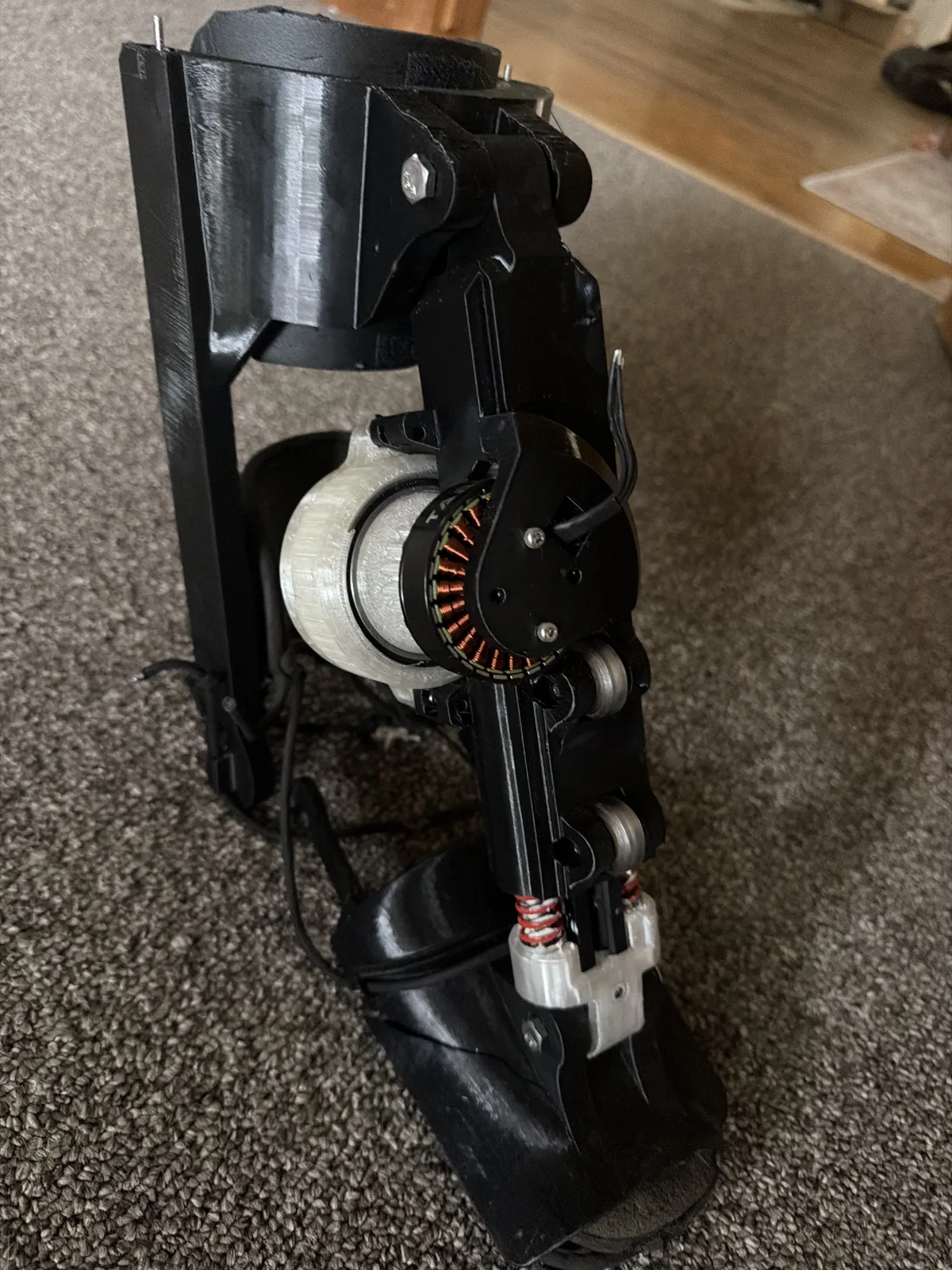
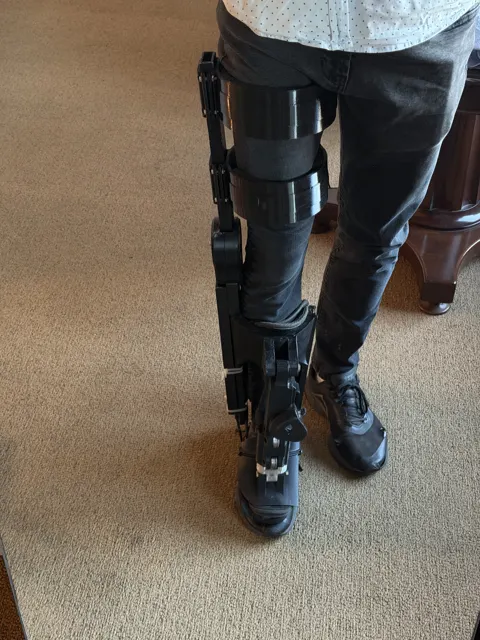
A powered ankle exoskeleton. A calf shell carries a brushless motor and a planetary gearbox, which drive a rack along an aluminium rail to push the shoe cup around the ankle.
- Joint
- Ankle revolute, 1 DOF
- Motor
- Tarot 5010 brushless
- Reduction
- 1-stage planetary, 4 planets
- Output
- 24T pinion on rack, 2020 V-slot
Built around one leg.
The shell is shaped from a scan of my own left calf, so the load path runs through soft tissue I measured, not an average.
Motor to ankle, in four steps.
The ring gear is fixed to the housing, so the carrier turns slower than the sun and with more torque. The pinion on the carrier walks the rack along the rail, and the rail pushes the toe side of the shoe cup.
Gear motion in this mock is driven from the ankle angle with estimated ratios.
Every part, apart.
Then I built it.
The model you just watched come apart is the one I printed, wired and wore. Every body came straight out of the Fusion 360 design, in its real position.
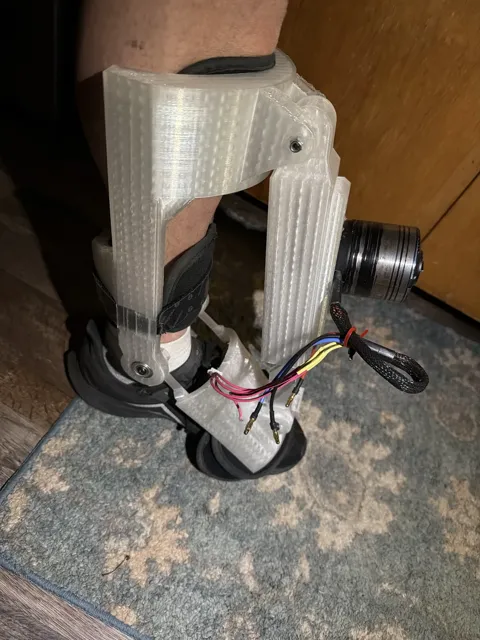
v1Clear PETG, first fit on the leg 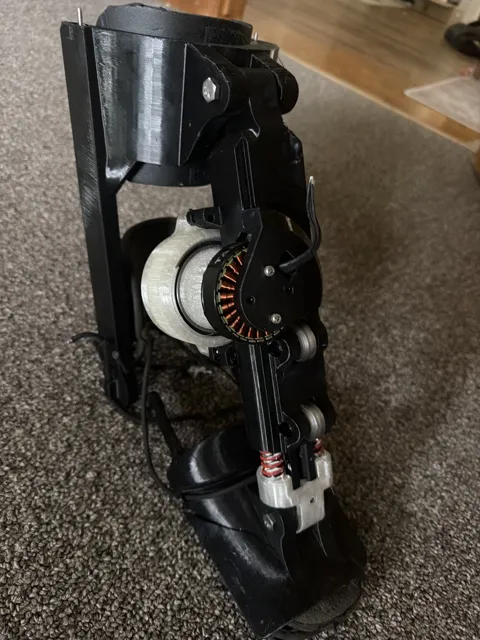
v2Black PLA, motor and rail fitted 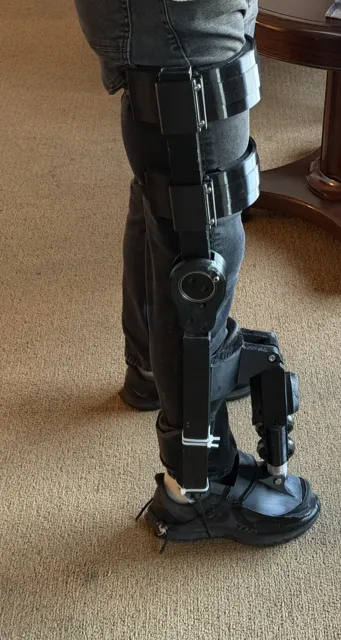
v3Worn with the knee module
Then it has to walk.
This is the whole brace from Fusion: the Kicker at the ankle, two die springs along the rail, a knee hinge on a pair of 45 mm bearings, and two cuffs around the thigh. The hinge follows the knee through every step.
The knee is nearly straight when the heel lands, bends about 18° to soak up the hit, straightens, then folds to about 60° so the toes clear the floor. The Kicker can only point the foot down, so it does the push-off at the end of stance.
Model: Assembled BRace v6 with The Kicker v22. Drag the plot to scrub the stride. The curve is an average adult profile, not a measurement of me.
Water, on crutches.
On crutches both hands are busy, so you can't carry a drink. Water Break is a printed helical cage that hooks onto the two rails of a standard aluminium crutch, below the hand grip. A water bottle drops into it.
The walk is the one-crutch gait: the crutch and the left foot go forward together, then the right foot steps through past them.
The bottle swings with the crutch but the water doesn't. Gravity sets the surface, so all the swing can do is make it slosh. The cap stays on, so nothing spills.
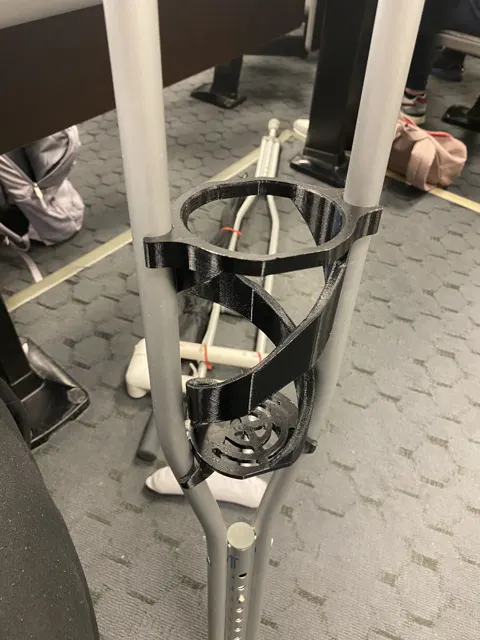
Model: Water Break, from Fusion. The crutch and bottle are stand-ins sized to its hooks. The slosh is a damped spring on top of first-order physics, not a fluid simulation.
A knee scooter with a belt drive.
Knee scooters are slow on purpose. This one has a C6374 outrunner under the deck driving the rear right wheel through an HTD 3M belt, a throttle on the bars, and a basket because it still has to be useful. The left leg stays free; the right knee rides the pad.
Here it weaves a line of cones down the sidewalk by itself. The belt is on this side, inside the rear right wheel.
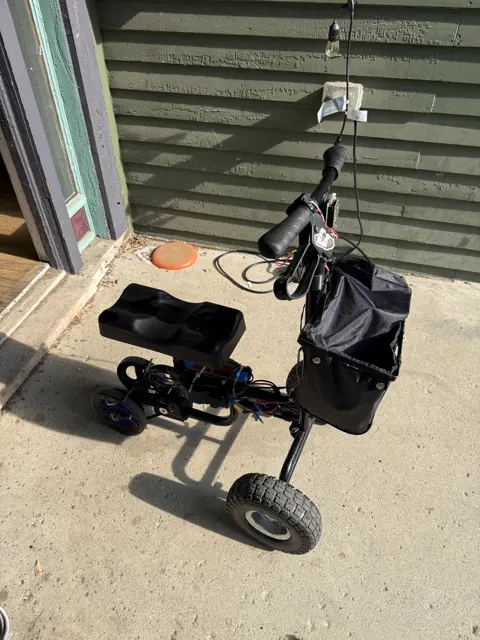
Model: Scooter Asm v6. Wheels, steering and the knee pad move on their Fusion joints; the motor turns at the belt ratio. The sidewalk and cones are stand-ins.
Fast motor, slow wheel.
An outrunner like the C6374 makes its power at high speed and low torque, and a scooter wheel wants the opposite. The belt trades one for the other. A small pulley on the motor drives a big one bolted to the wheel, so the motor turns several times for each turn of the wheel and the wheel gets that many times the torque.
Twelve parts, pulled apart.
It rolls to a stop and comes apart. The motor lifts off its mount, the belt slides off both pulleys, the wheel pulley comes out of the rear right wheel, and the battery pack drops out of the frame.
Model: Scooter Asm v6. Each part moves along its own offset; the rider goes see-through so the parts behind show.
Take the bars.
Left alone, it keeps weaving the cones. Press a key and it is yours. With a 51 cm wheelbase the turning circle falls straight out of the geometry.
Drive with WASD or the arrow keys, or steer with the slider; Space hops, high enough to clear a cone. The ramps beside the cones are kickers to jump off; the autopilot weaves the other way and never touches them. Leave it for 3 seconds and the autopilot takes it back to the cones. A cone you hit falls over and stands back up.
A couch that drives sideways.
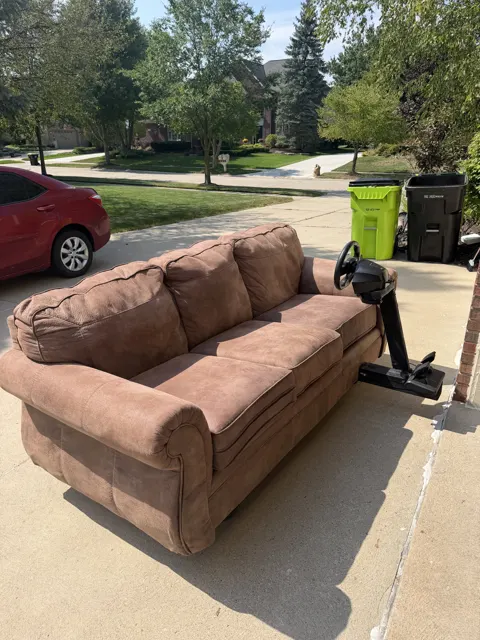
A full-size sofa on four swerve modules. Each corner has its own drive motor and its own steering motor, so the couch can slide in any direction and spin at the same time. I drive it from the seat with a Thrustmaster T128 wheel and its pedals on a wheel stand.
Every module solves one line of vector math: its wheel has to move at the couch's velocity plus what the spin adds at that corner.
Drive it like a car with WASD or the arrows and the camera drops in behind you: the front modules hold Ackermann angles, the rear ones stay straight, and it grips like a normal car. Hold Shift to drift: the steering oversteers and the back end steps out. Space is the handbrake. Off the throttle, A and D spin it on the spot like a tank, and a faint arrow on the floor shows where the steering points. Double-tap A or D and the steering swings 90° round the couch, so it drives sideways like a car; while you drive, the street bends left into a roundabout, and two gates plus a drift lap round the roundabout make a timed lap. Leave it and it goes back to showing off sideways moves only a swerve base can do; the spin slider drives that. Past 90° a module reverses its wheel instead of steering all the way round. The red steering rings are the hub from Fusion (Steering hub v9). The wheel and pedals are modelled from Thrustmaster's published dimensions; the sofa, stand and wheels are stand-ins, and the street is a simulation. Scroll on and it drives to the fire.
A lamp that plays with the cat.
Assym Restore stands on the mantel. An MG996R servo in the base turns everything above it through its full 180°, and a 9 g servo tilts the laser through a horn and a push rod. Two angles put the dot on the floor wherever you point.
Move your cursor across the floor. The cat does the rest, goes round the couch and the hearth to get there, and jumps up onto the cushions when the dot lands on the couch.
Model: Assym Restore v7, from Fusion. The pivots come from the holes in the model; the joint limits are worked out from the linkage, not documented. The mantel is a stand-in. On a phone, touch and drag.
Assym Restore, at play.
Before it comes apart, a slow look at it whole. Here it plays the way it does for the cat: the base stays put while the pan servo darts the head a little to each side and the tilt servo flicks the laser up and down, holding and wiggling the dot between moves, so you can watch the shade, the slot and the linkage work.
Solid, as modelled: Assym Restore v7 from Fusion. The moves are a scripted imitation of play, not a recording.
Thirteen parts, seen through.
The shade, cap and base turn translucent, so the internals show through them. The MG996R pan servo sits on the base with its spline in it, the 9 g tilt servo stands in its housing and pushes the laser's crank through the rod, the ESP32-CAM faces forward under the laser, and two 3 W speakers sit inside the base.
Model: Assym Restore v7. The ESP32-CAM's board parts are simple blocks in the model, so they show as blocks here too.
Still on the bench.
These are in Fusion and not finished yet.
- Flying Bike
- Pipe organ
- ShoppingKart · Honda GX390
- Printers Printing Printers
- Bedside table
- Torque tester
More from the bench.
Open one to turn it over, pull it apart and see how it goes together.